Suppose That You Continually Collect Coupons and That There Are M Different Types
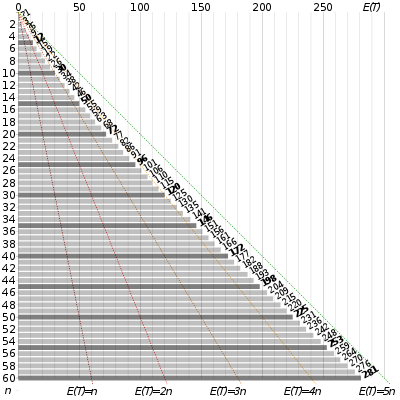
Graph of number of coupons, n vs the expected number of trials (i.e., time) needed to collect them all, E (T )
In probability theory, the coupon collector's problem describes "collect all coupons and win" contests. It asks the following question: If each box of a brand of cereals contains a coupon, and there are n different types of coupons, what is the probability that more than t boxes need to be bought to collect all n coupons? An alternative statement is: Given n coupons, how many coupons do you expect you need to draw with replacement before having drawn each coupon at least once? The mathematical analysis of the problem reveals that the expected number of trials needed grows as .[a] For example, when n = 50 it takes about 225[b] trials on average to collect all 50 coupons.

Solution [edit]
Calculating the expectation [edit]
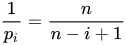
Let time T be the number of draws needed to collect all n coupons, and let ti be the time to collect the i-th coupon after i − 1 coupons have been collected. Then . Think of T and ti as random variables. Observe that the probability of collecting a new coupon is . Therefore, has geometric distribution with expectation . By the linearity of expectations we have:




Here Hn is the n-th harmonic number. Using the asymptotics of the harmonic numbers, we obtain:

where is the Euler–Mascheroni constant.

Using the Markov inequality to bound the desired probability:

The above can be modified slightly to handle the case when we've already collected some of the coupons. Let k be the number of coupons already collected, then:
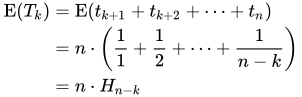
And when then we get the original result.

Calculating the variance [edit]
Using the independence of random variables ti , we obtain:

since (see Basel problem).

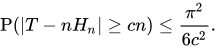
Bound the desired probability using the Chebyshev inequality:
Tail estimates [edit]
A stronger tail estimate for the upper tail be obtained as follows. Let denote the event that the -th coupon was not picked in the first trials. Then


![{\displaystyle {\begin{aligned}P\left[{Z}_{i}^{r}\right]=\left(1-{\frac {1}{n}}\right)^{r}\leq e^{-r/n}.\end{aligned}}}](https://wikimedia.org/api/rest_v1/media/math/render/svg/8c12757cabf87eff67732f4ea2e2f3042b8d2042)
Thus, for , we have . Via a union bound over the coupons, we obtain

![P\left [ {Z}_i^r \right ] \le e^{(-\beta n \log n ) / n} = n^{-\beta}](https://wikimedia.org/api/rest_v1/media/math/render/svg/916bd3a3939a0a68c3c412c893da118eb58826c5)

![{\displaystyle {\begin{aligned}P\left[T>\beta n\log n\right]=P\left[\bigcup _{i}{Z}_{i}^{\beta n\log n}\right]\leq n\cdot P[{Z}_{1}^{\beta n\log n}]\leq n^{-\beta +1}.\end{aligned}}}](https://wikimedia.org/api/rest_v1/media/math/render/svg/26b6afb27c12cc574efc8ad9f6c6524da3ba8adc)
Extensions and generalizations [edit]
- Pierre-Simon Laplace, but also Paul Erdős and Alfréd Rényi, proved the limit theorem for the distribution of T. This result is a further extension of previous bounds. A proof is found in.[1]

- Donald J. Newman and Lawrence Shepp gave a generalization of the coupon collector's problem when m copies of each coupon need to be collected. Let Tm be the first time m copies of each coupon are collected. They showed that the expectation in this case satisfies:
-
- Here m is fixed. When m = 1 we get the earlier formula for the expectation.

- Common generalization, also due to Erdős and Rényi:

- In the general case of a nonuniform probability distribution, according to Philippe Flajolet et al.[2]

- This is equal to
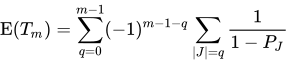
- where m denotes the number of coupons to be collected, and PJ denoting the probability of getting any coupon in the set of coupons J.
See also [edit]
- Watterson estimator
- Birthday problem
Notes [edit]
References [edit]
- ^ Mitzenmacher, Michael (2017). Probability and computing : randomization and probabilistic techniques in algorithms and data analysis. Eli Upfal (2nd ed.). Cambridge, United Kingdom. Theorem 5.13. ISBN978-1-107-15488-9. OCLC 960841613.
- ^ Flajolet, Philippe; Gardy, Danièle; Thimonier, Loÿs (1992), "Birthday paradox, coupon collectors, caching algorithms and self-organizing search", Discrete Applied Mathematics, 39 (3): 207–229, CiteSeerX10.1.1.217.5965, doi:10.1016/0166-218x(92)90177-c
- Blom, Gunnar; Holst, Lars; Sandell, Dennis (1994), "7.5 Coupon collecting I, 7.6 Coupon collecting II, and 15.4 Coupon collecting III", Problems and Snapshots from the World of Probability, New York: Springer-Verlag, pp. 85–87, 191, ISBN0-387-94161-4, MR 1265713 .
- Dawkins, Brian (1991), "Siobhan's problem: the coupon collector revisited", The American Statistician, 45 (1): 76–82, doi:10.2307/2685247, JSTOR 2685247 .
- Erdős, Paul; Rényi, Alfréd (1961), "On a classical problem of probability theory" (PDF), Magyar Tudományos Akadémia Matematikai Kutató Intézetének Közleményei, 6: 215–220, MR 0150807 .
- Laplace, Pierre-Simon (1812), Théorie analytique des probabilités, pp. 194–195 .
- Newman, Donald J.; Shepp, Lawrence (1960), "The double dixie cup problem", American Mathematical Monthly, 67 (1): 58–61, doi:10.2307/2308930, JSTOR 2308930, MR 0120672
- Flajolet, Philippe; Gardy, Danièle; Thimonier, Loÿs (1992), "Birthday paradox, coupon collectors, caching algorithms and self-organizing search", Discrete Applied Mathematics, 39 (3): 207–229, doi:10.1016/0166-218X(92)90177-C, MR 1189469 .
- Isaac, Richard (1995), "8.4 The coupon collector's problem solved", The Pleasures of Probability, Undergraduate Texts in Mathematics, New York: Springer-Verlag, pp. 80–82, ISBN0-387-94415-X, MR 1329545 .
- Motwani, Rajeev; Raghavan, Prabhakar (1995), "3.6. The Coupon Collector's Problem", Randomized algorithms, Cambridge: Cambridge University Press, pp. 57–63, ISBN9780521474658, MR 1344451 .
External links [edit]
- "Coupon Collector Problem" by Ed Pegg, Jr., the Wolfram Demonstrations Project. Mathematica package.
- How Many Singles, Doubles, Triples, Etc., Should The Coupon Collector Expect?, a short note by Doron Zeilberger.
Source: https://en.wikipedia.org/wiki/Coupon_collector%27s_problem
0 Response to "Suppose That You Continually Collect Coupons and That There Are M Different Types"
Post a Comment